Re-Dedication Celebration of Great Point Lighthouse
by Sarah Teach
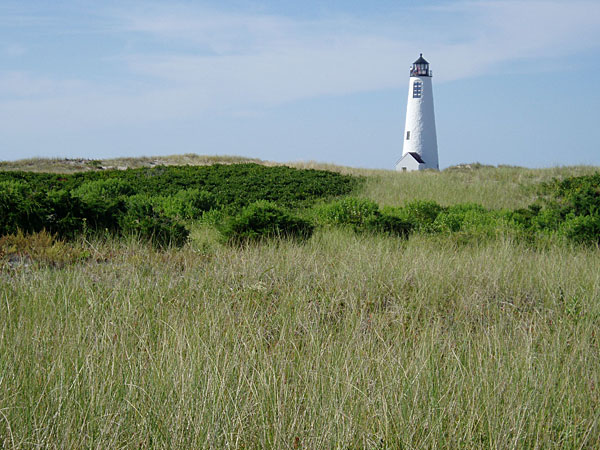
A symbol of Nantucket’s shoreline, the lighthouse at Great Point has been an island icon for hundreds of years. It has withstood wreckage and rebuilding, maintaining its important seaside spot and serving as a beacon for mariners and tourists. To celebrate the 25 years that the current structure has operated, The Trustees of Reservations, U.S. Coast Guard, and the U.S. Fish and Wildlife Service (USFWS) will host a free, public event. On Friday, September 2 from 10 a.m. to 4 p.m., USFWS and The Trustees of Reservations staff will offer interpretative tours of the lighthouse and the National Wildlife Refuge on which it sits. During this time, entrance fees for 4x4 oversand vehicles will be waived so that visitors can drive out to Great Point and enjoy a tour or just a fun day on the beach!
Great Point Lighthouse, also known as Nantucket Lighthouse, sits at the end of a seven-mile-long strip of sand at the northern tip of Nantucket, overlooking the gap between Nantucket and Monomoy Island that connects Nantucket Sound to the Atlantic Ocean. By the late 1700s, this passage was one of the busiest areas on the East Coast, mostly due to the thriving whaling industry. However, its hidden shoals and strong, unpredictable currents made navigating it a difficult challenge. The earliest recorded mention of a lighthouse at Great Point (then known as Sandy Point) was in 1770, when the town leaders of Nantucket formed a committee to ask the General Court of Massachusetts to build “a lighthouse on the end of Sandy Point of Nantucket.”
The Revolutionary War temporarily delayed the lighthouse campaign for a few years, but afterward, the committee was replaced by a single representative, who was instructed to “use his Influence in the General Court to get a Light House on our Point according to his own Discretion.” The first wooden tower was completed in 1785. In 1816, it was destroyed by fire. A new 60-foot stone tower was finished in 1818 at a cost of about $7,400. After more than one hundred years of being lit by keepers, the lighthouse was automated in the 1950s, and the keeper’s house was boarded up and abandoned. (Today, you won’t see the dwelling; it was destroyed in 1966 by a suspected arson fire.) In 1971, the Fresnel lens was replaced by a 190mm solar-powered modern optic.
Through the 1970s and 1980s, erosion brought the tower closer and closer to the water. Although the Coast Guard repainted and refurbished the tower in 1983, no action was taken to actually move it away from the water, although discussions continued. Then on March 29, 1984 a hurricane-force storm toppled the lighthouse and cut through the barrier beach, leaving the remains of the tower on an island. The Coast Guard proposed putting a skeleton tower at the site as a replacement, but local residents successfully resisted the idea, instead calling upon the influence of Senator Ted Kennedy. Less than two years later, the Senator had secured two million dollars in federal money to reconstruct the lighthouse. The new tower, which includes some material from the 1818 lighthouse, was built three hundred yards west of its former location. Its dedication occurred on September 7, 1986 with Senator Kennedy raising a flag, smashing a bottle of champagne against the lighthouse, and declaring “Great Point is alive and well again.”
Today, the lighthouse and Great Point area is in the care of The Trustees of Reservations, a 120-year-old organization that looks after 105 spectacular “reservations” located on more than 26,000 acres in 75 Massachusetts communities. On Nantucket, The Trustees provide fishing, lighthouse, sunset, and natural history tours, in addition to their partnership with the Nantucket Conservation Foundation in selling oversand permits for 4x4 vehicles. The Trustees are committed to being a force of action in creating a sustainable future and are working to promote healthy, active, green communities around the state by providing hundreds of year-round programs and events that inspire people of all ages to enjoy the outdoors and appreciate the history, nature, and culture of the Commonwealth. Most programs and events are free of charge or heavily discounted for members.
Accredited by the Land Trust Accreditation Commission, The Trustees are an established leader in the conservation and preservation movement. One of the largest non-profits in Massachusetts, The Trustees employ 152 full-time, 49 regular part-time, and 400 seasonal staff with expertise in ecology, education, historic resources, land protection, conservation, land management, and planning. To find out more or how to become a member, donor, or volunteer, please visit www.thetrustees.org.