Remembering WWII on Nantucket
by Kenneth Turner Blackshaw
George was born on Nantucket, at the Cottage Hospital on West Chester Street, October 23, 1934. His Dad was William (Bill) Allen who worked in Allen’s family Restaurant, now the Club Car, and his Mom was Evelyn Nickerson Allen. George is retired now, having operated a successful radio and TV business on Nantucket for 50 years.
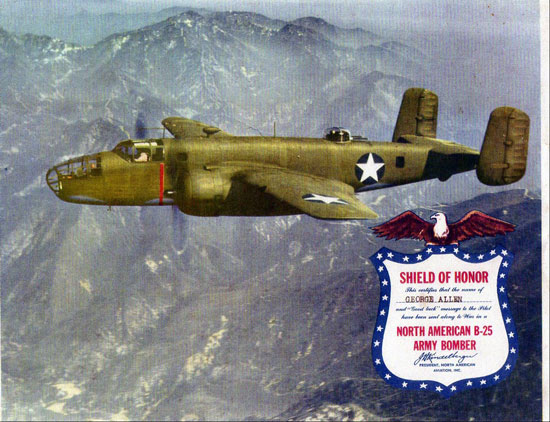
We got together one January morning in his cellar radio shack, he being a licensed radio amateur with callsign N1NBQ. What started this conversation was a picture of a World War II B-25 bomber framed on the wall. George told me it came in response to his sending in a cereal box top over 60 years ago. This led to a discussion of how young folks kept themselves entertained on this lonely island during hard times.
As George told me not everyone even had a telephone. Some that did had “party-lines.” You shared your line with others and the ring pattern told you when a call was coming to YOU. Others might be listening in but of course that was a big “no-no!” Families considered themselves lucky to have one radio that allowed them to listen to commercial broadcasts.
Radio was the home entertainment back then. For kids there were adventure programs every weekday afternoon, mostly sponsored by food companies, like Wheaties, Kix, or Ovaltine. The companies used their packaging to get kids to listen to these adventures and the programs got you to buy more of their product.
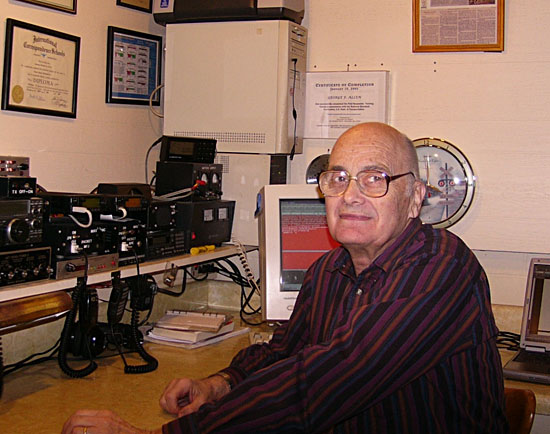
George Allen - 2009
George commented, “About 4:30-5 o’clock in the afternoon a bunch of children’s shows started, like ‘Terry and the Pirates,’ ‘Captain Midnight,’ ‘Sky King,’ ‘Jack Armstrong,’ – all these types of people who were involved with fighting the war.” George made the point that the fact that we were at war dominated everything about people’s lives. You can imagine the impact on young people growing up who hadn’t known any other way of life.
George’s family had a table radio in the kitchen so they could listen to these programs during supper. Most of the stations were in Boston or Providence – nothing closer to Nantucket.
George’s comment was all the boys in town would listen to the afternoon adventure programs. After school there would be an hour or so when kids could go out and play and everyone would talk about what Jack Armstrong or Terry and the Pirates were doing. Some kids would have an inkling about what would happen on tonight’s program and they were hot stuff! More on that later.
So at 4:30 pm, everyone would have to go home to catch these programs and also to hear about the deals the sponsors had that would give you an edge to know what secret things were actually happening on these programs. Available were things like secret ring decoders or glow-in-the-dark badges. The shows would take you to wartime scenes in darkest Africa, or flying over enemy territory on secret missions. The planes themselves were often camouflaged so average folks wouldn’t recognize them.
One episode found one of these missions with a bomb on board. A girl who happened to be one of the plane’s crew discovered this. George wasn’t sure how she came to be there but as she was going to sleep, she heard the bomb ticking. Of course kids all over the country heard this ticking going on right with her. Nobody was leaving their radio that afternoon!
As George pointed out, “Sometimes everyone was on tenterhooks wanting to know what the next episode was going to be about. In order to find that out that you had to have one of these decoder rings. To get one you had to buy ‘so many’ boxes of cereal and save the box tops and mail them, along with several coins, in to places like Battle Creek, Michigan. Then you had to wait – and wait – seemed like forever, until the ring would arrive. In the meantime other kids that did have the rings would know stuff you didn’t know.”
George chuckled at this point. Apparently the cereal companies had a shortage of box tops during the war so the kids had to help them out by sending lots of these tops back to them.
Anyway there would be a code at the end of each program and if you had a decoder ring you would get a clue. If someone was being held captive the clue might be, “Tom escapes.” Then you’d have some consolation that everything was going to work out okay tomorrow.
Every program had a different way of building excitement this way and also promoted a different cereal box offer that would allow you to send off for a gadget that would give you an edge on your friends. You’d have a secret that no one else knew about.
George commented that there are now internet sites you can go to where you listen to these programs and hear the box top offers. Of course no one has to wait for the next episode any more. Just click on the next web page and secrets are instantly revealed. Might it be better to wait until the next day? Not in this day and age.
Another radio offer said you needed to buy two boxes of cereal, labeled ‘box one’ and ‘box two.’ Next day George went to the little grocery store on the corner of Orange and Dover Street to get the boxes. The clerk found box one right away but then George needed box number two as well. The poor guy had to take every box off the shelf before they found a box number two. Now what was this? It was a little stage about four inches square with a little teeny plane you cut out and glued together. Then you used sewing thread to connect cardboard controls so you could control the plane just like a real one. But the cardboard gave out quickly so the entertainment didn’t last too long. You had to eat a lot of cereal.
One cereal box offer was to send in a box top with your name and they would engrave your name inside one of these planes that was actually flying a mission in the war – at least that’s what people were told. Anyway the plane would go to war with you wishing good luck to the crew. In exchange they’d send you a picture of the plane and that’s where George’s B-25 picture came from well over half a century ago.
George remembered other cereal boxes had activities printed on them. You could make a plane model out of items that you would cut out of the box. Of course you had to eat the cereal first. American planes, German planes, Japanese planes. All the kids had collections.
These adventures shaped everyone’s lives but they also linked their thoughts to the war that was going on. This war didn’t seem so far from Nantucket since there were U-boat sightings and also round-the-clock plane spotting duties from the area around the Old Mill and near the Water Tower.
The Navy had taken over Nantucket Airport and there was no private aviation at all. George’s Dad had his own plane and it had to be completely taken apart and stored in pieces in many different locations for security reasons. Their plane, a yellow Fairchild with a dark blue stripe had the wings, engine, and fuel tank stored in their garage. George had to be very careful when playing there so as not to tear the fabric on the wings.
George also mentioned things that every family was encouraged to do to help with the war effort. You had to hammer all your tin cans flat and turn them in. Food rationing was in effect. All cars had the top part of their headlights painted with aluminum paint to make them less visible to aircraft at night and a sticker on the windshield showing how many gallons of gas they were allowed per week.
He also remembered near the end of the war people were being asked to pick as many milkweed pods as possible. George collected about a bushel personally. These milkweed pods were then used to fill life preservers. He remembers a picture of this in the Inquirer and Mirror.
School children were very involved in the war effort. Civil Defense had plane spotters located at several places around town, Old Mill, the yellow Golf Club building on Cliff Road were two of the many locations volunteers staffed these places for enemy plane spotting. Back at school students were instructed to make a colored drawing paper sign to hang around their neck – Red teams, yellow teams, green teams, blue teams. Certain sixth grade kids were chaperones and responsible for getting kids in their group home. Everyone went home for lunch. The signs had your name and address on it with punched holes in the corners to be worn around your neck on a string. The signs had to be kept in your desk on top of everything else. Sometimes at lunchtime as you went home you wore your ID and went along with your group leader as a drill. Instructions were to walk down the middle of the street. That was okay since there were no cars on the road — because gas was rationed, almost no one drove. About a gallon of gas a week was all a family got. You almost never saw a car on the road. You’d walk home with your troop leader. Get dropped off. Then you had to be sure to bring your ID back with you.
George remembers, “One day in the afternoon, as soon as we sat down after lunch, the teacher was called to the door. Then she instructed all the kids to put on their IDs, go home and stay at home. No one was told why. There was nothing on the radio about it. Next morning back to school the rumor was that some spotter had misidentified an airplane as an enemy plane and thought they were under attack.”
It was a very different Nantucket Island back then but kids still got to go out and play. The adventure programs on the radio gave them entertainment as well as allowed them to link their games to the war effort. A few box tops and a few coins were all that was required to keep busy young minds active. George doesn’t remember anyone getting bored.
Ken Blackshaw is an accomplished writer, mainly on Natural History subjects. He writes the "Birds of Nantucket" column weekly in the Nantucket Independent. To find out more about him and his series of books on Nantucket's birds go to: http://k-blackshaw.com/BN/BN.htm